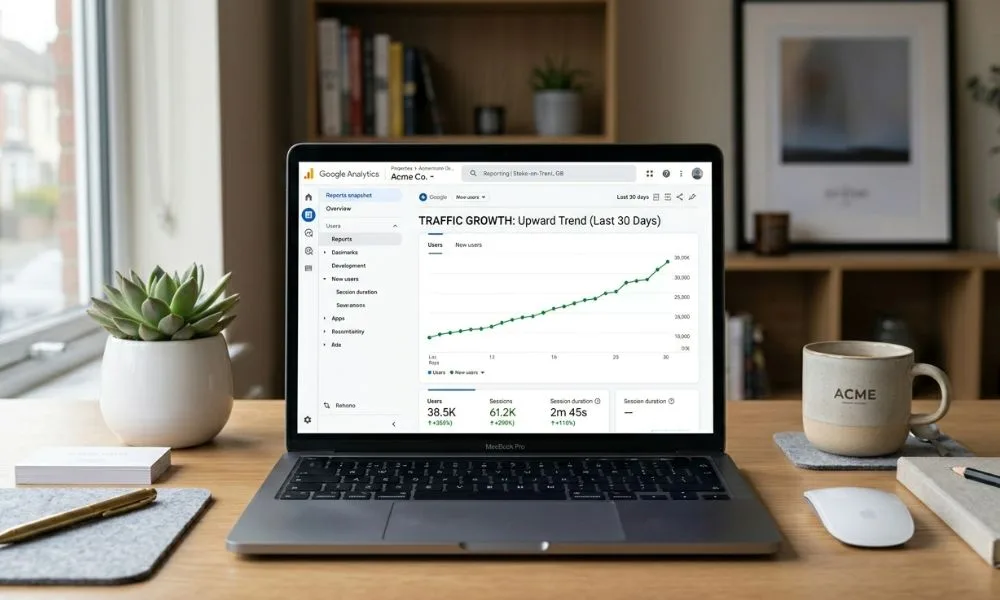
Local SEO gets talked about constantly and explained badly almost as often. Most guides either bury you in technical jargon or reduce it to advice so basic it is useless. This is neither. Here is a plain-English explanation of how local SEO actually works for small businesses in Stoke-on-Trent, and what you can do about it.
What local SEO actually is
Standard SEO is about ranking in Google for general searches. Local SEO is specifically about ranking in searches that have a location attached, either explicitly ("plumber Stoke-on-Trent") or implicitly ("plumber near me" searched from a phone in Stoke).
When someone does a local search, Google shows two things. First, the map pack: usually three business listings with a map above them. Second, the regular organic results below that. Local SEO covers both. Getting into the map pack and ranking in the organic results are related but not identical problems, and good local SEO addresses both.
The three things Google looks at for local rankings
Google uses three main signals to decide which local businesses to show, and how high up.
Relevance
Does your business match what the person is searching for? This is why your Google Business Profile category matters, why your website content needs to describe what you actually do, and why vague or generic descriptions hurt you. "We offer a range of professional services" tells Google nothing. "We are a Stoke-on-Trent electrician covering domestic rewires, fuse board upgrades, and EV charger installation" is far more useful.
Distance
How close is your business to the person searching? You cannot change your location, but you can make sure Google knows exactly where you operate. Set your service area accurately on your Google Business Profile. Mention specific towns and areas on your website. Hanley, Burslem, Longton, Tunstall, Newcastle-under-Lyme, wherever you genuinely work.
Prominence
How well-known and trusted is your business online? This is where reviews, backlinks, and consistent mentions of your business name and address across the web all come in. A business with 40 genuine Google reviews and a mention on a local directory will outrank a business with no reviews and no external presence, all else being equal.

Your website and local SEO
Your Google Business Profile handles the map pack side of things. Your website handles the organic results below it, and the two reinforce each other.
For local SEO, your website needs pages that clearly describe your services and include your location. Not stuffed with keywords, just written naturally for a person in Stoke who is looking for what you do. A page titled "Electrician in Stoke-on-Trent" that covers the services you offer, the areas you cover, and has a genuine contact option will rank for those searches over time.
Blog content also helps. Answering the questions your customers actually ask, in plain language, builds up your site's relevance and authority gradually. It is slow, but it compounds. A business that has published twenty useful local articles over two years will be significantly harder to dislodge from the search results than one that has not.
Citations and consistency
A citation is any mention of your business name, address, and phone number online. Google uses these to verify that your business is real and established. The more consistent these are across directories, the better.
Check that your business name, address, and phone number are identical everywhere they appear. Not almost identical. Identical. "Stu's Electrical Services, 12 High Street, Stoke-on-Trent, ST1 1AA" and "Stu's Electrical, High Street, Stoke" are not the same to Google's crawlers.
Start with the basics: Google Business Profile, Yell, Yelp, and any trade-specific directories relevant to your sector. Then work outward.

How long does local SEO take?
Honest answer: months, not weeks. A brand new website with no history will not rank on page one for competitive local terms inside the first month. That is just the reality. What you can control is starting sooner and being consistent.
Businesses that commit to the basics, a well-optimised website, an active Google Business Profile, regular reviews, and some local content, typically see meaningful movement in three to six months. Competitive terms in saturated markets take longer.
If you want to understand what you should be paying for this kind of ongoing support, the small business website cost guide for Stoke-on-Trent covers the pricing honestly.
Start building your local presence
Local SEO is not a one-off fix. It is something you build over time. As a local SEO company in Stoke-on-Trent, DesignedByStu handles all of this as part of the £199 monthly plan, including Google Business Profile management, local content, and ongoing optimisation. See what is included.
If you are outside the city, the same approach applies right across the county. Here is how web design in Staffordshire works on a monthly basis.
Need a website for your business?
Monthly packages from £99. Live in 1 week. No upfront costs.
View packages →